
The Hidden Benefits of Standardizing Event Technology
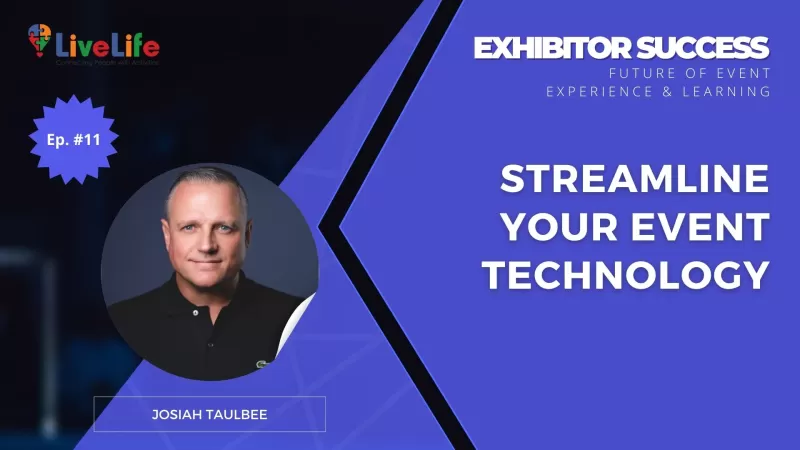
Benefits of standardizing event technology — When technology becomes a tower of babel? Every event organizer has felt it — the endless search for the "right" event tech solution.
This is the summary based on The FEEL Podcast with Josiah Taulbee.
One platform promises seamless engagement, another guarantees AI-driven insights, and yet another claims to "do it all." But when you try to compare them, it's chaos.
Different features, different terms, no consistent way to measure or understand what's actually being offered.
That's where the benefits of standardizing event technology come in.
As explored in The FEEL #11: Which Event Tech Will Drive Exhibition Success?, Josiah Taulbee, founder of the Certified EventTech Classification Initiative (CECI), likens today's event tech landscape to building with mismatched Lego blocks — they look similar but don't quite fit together.
And that lack of standardization doesn't just waste time — it limits innovation, collaboration, and trust across the entire industry.
Why Standardization Matters More Than Ever
In an industry racing toward digital transformation, standardization might sound like a dull, administrative topic. But here's the truth: it's the quiet foundation that enables everything else — innovation, comparison, benchmarking, and even creativity.
Without it, organizers and vendors are stuck speaking different languages. The same feature might have five different names. The same solution might be marketed in ten different ways.
It's no wonder event professionals feel lost.
But here's the part most people miss: standardizing event technology doesn't restrict flexibility — it unlocks it. By creating a common framework, professionals finally gain the clarity to make confident decisions.
The Lego Analogy: Building Without a Master Template
Josiah shared a simple but powerful analogy in The FEEL #11:
"It's like trying to build with Legos — but every piece is shaped differently. Some don't fit. Some won't connect at all."
That's what happens when event technology lacks a shared structure.
Each provider builds their own "version" of a block. Organizers try to piece them together — but the result rarely forms a cohesive system.
With standardization, however, every piece is designed to connect. Suddenly, organizers can see how each tool fits into the bigger picture. Vendors can align their messaging. Associations can benchmark performance.
And collectively, the industry can move from trial-and-error to strategy and synergy.
The Key Benefits of Standardizing Event Technology
Standardization isn't just about labeling or creating categories. It's about alignment — of language, expectations, and outcomes. Here are some of the biggest benefits shaping the future of event innovation:
1. Simplified Decision-Making for Organizers
When every solution is defined by a consistent framework, comparison becomes easy.
Instead of getting lost in buzzwords like "hybrid," "immersive," or "AI-powered," organizers can evaluate tools based on function and fit.
That clarity speeds up research, reduces frustration, and ensures investments actually meet event objectives.
2. Stronger Vendor Positioning
For vendors, standardization means no more guessing how to explain what their solution does.
By aligning with standardized categories, they can highlight their strengths with precision — and be discovered by buyers searching for exactly those capabilities.
It also levels the playing field: no more marketing spin, just real value.
3. A Shared Language Across the Industry
This might be one of the most underrated benefits of standardizing event technology — communication.
When everyone uses the same terminology, conversations between organizers, exhibitors, and vendors become productive instead of confusing.
As Josiah noted in the podcast, "It allows us to finally talk about event tech using the same language."
And that shared language doesn't just make meetings smoother — it accelerates learning, benchmarking, and innovation across borders.
4. Smarter Benchmarking and Measurement
Without standard definitions, comparing event outcomes is like comparing apples to oranges.
But with a consistent classification system, metrics become meaningful. Organizers can evaluate ROI across different tools. Vendors can prove effectiveness. Associations can collect standardized industry data.
It's the foundation for true evidence-based innovation in event design and delivery.
5. Unlocking Strategic Thinking
Right now, most organizers think tactically — "What tool solves this one problem?"
Standardization shifts the mindset toward strategy — "Which classifications of technology are we using? Which ones are missing? What combinations create the best attendee experience?"
That's the leap Josiah described in The FEEL #11 — from operational fixes to long-term ecosystem thinking.
But Here's the Part Most People Miss…
Standardization isn't about control. It's about connection.
When systems, platforms, and people align on shared definitions, collaboration becomes possible. The industry can start innovating together instead of in silos.
That's when real progress happens — when we can finally benchmark across events, learn from each other, and push the boundaries of experience.
And yet, there's one strategy rarely discussed: how standardization itself can become a catalyst for creative innovation — not just efficiency.
That's the surprising insight revealed in The FEEL #11.
The Takeaway: Clarity Creates Connection
Without structure, the event technology landscape will always feel fragmented — like mismatched Lego pieces.
But when the industry embraces the benefits of standardizing event technology, something powerful happens: organizers gain clarity, vendors earn credibility, and innovation finally scales with consistency.
The question now isn't why we should standardize — it's how soon we can make it happen.
Want to discover the next step — and how standardization is already transforming exhibitions worldwide?
Watch the conversation on The Feel Podcast.
Need personalized guidance on benefits of standardizing event technology?
Follow Mike Gunawan on Linkedin

FAQs About the Benefits of Standardizing Event Technology
Q1: What does it mean to standardize event technology?It means creating a consistent framework and terminology for categorizing and evaluating event tech solutions, so everyone in the industry speaks the same language.
Q2: Why is standardization important in event tech?It reduces confusion, helps organizers compare tools effectively, and allows vendors to position their offerings more clearly.
Q3: How does standardization benefit event organizers?It simplifies vendor selection, enhances ROI tracking, and ensures event tools integrate smoothly for better attendee experiences.
Q4: WhatThey gain clearer visibility, stronger credibility, and more targeted conversations with potential clients.
Q5: How does this help the broader event industry?It enables benchmarking, fosters collaboration, and sets the foundation for global innovation and shared growth.
Main Article

Related Articles
Banner

Write a comment