
Inclusive Design
Author: Michael Arief Gunawan
Created: Saturday, 27 Jun 2020
Updated: -
First, by no means am I an expert in design. I don't know much about design, never use a photoshop, and don't have much of an aesthetic taste. But I wanna share some of what I have learnt lately about design. When we hear the word design we might immediately think of graphics, colours, or illustrations.
While they are partly of what makes a design, for me design is more to making something that works, whether communicating your message or getting a job done. Because at the end of the day, we design to accomplish something, whether based on our functional, social, or emotional needs. It is the user experience that determines a great design.
Recently I read this article on Inclusive Design and would like to share some quotes (with " ") and my own insights which might be useful:
"Inclusive design is for those who want to make great products for the greatest number of people"
It is important for us to be as inclusive as possible. We shouldn't simply use our biased perception on what is 'normal' because different people see, hear, say, touch and experience things differently. Or else "we end up with products designed for people of specific gender, language ability, tech literacy, and physical ability."
You might ask 'Why do we have to design for inclusivity?' Because it opens up the possibilities of our products & services being used to a wider range of people, even outside our intended audience. Especially since all of us as humans are growing, changing, adapting to the world around us everytime.
"Designing inclusively doesn't mean you're making one thing for all people. You're designing a diversity of ways for everyone to participate in an experience with a sense of belonging."
Here are the principles of inclusive design:
Recognize Exclusion
"Exclusion happens when we solve problems using our own biases." We assume what people can or can't do based on their abilities and disabilities. But these are just our assumptions. Furthermore, often disability is not something permanent like a personal health condition. "Disability happens at the the points of interaction between a person and society. Physical, coginitive and social exclusion is the result of mismatched (human) interactions."
For example, if we are designing for a deaf person, we might want to rephrase our target audience as 'someone who can't hear'. Their condition might be permanent deafness, temporary due to injury, or even situational being in a loud environment. Thus our target audience widens up. In 1874 Alexander Graham Bell created a device called phonoautograph that allowed deaf students to see the vibrations of a sound etched onto smoked glass. This work set a foundation for Bell to invent the telephone two years later. (this device was actually writing a sound using a human ear!)
.jpg)
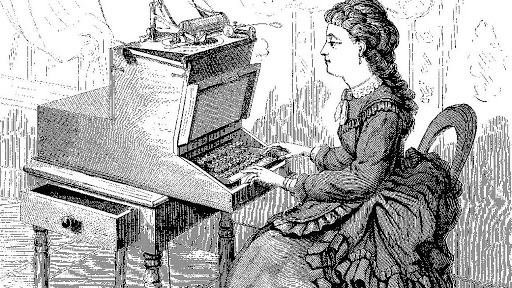
Did you know that Pellegrino Turri developed a typing machine so that his blind lover, Countess Carolina Fantoni, could send him love letters without the need for her to dictate to a scribe? Here is one of her love letters, the same principle of typing letter-keys are still used even on our handphone today! (Article here)
Learn from Diversity
"When experiences don't serve people the way they should, people adapt. Sometimes in astonishing ways that the designers never intended. We can try to imagine how a person with a given set of abilities would use an experience, but we can't imagine their emotional context, what gives them joy or frustates them. Insights come when we understand those adaptations, and from what's shared across everyone's experiences."
Are people forced to adapt to our design? Or our design is adapting to their needs?
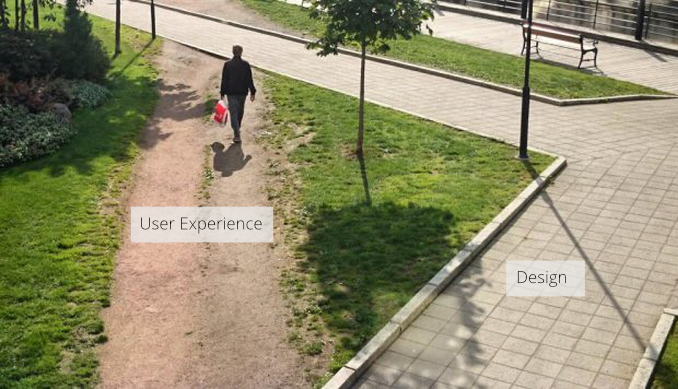
"Empathy is an important part of many different forms of design. Learning how people adapt to the world around them, means spending time understanding their experience from their perspective. When done well, we can recognize more than just barriers that people encounter. We also recognize the motivations that all people have in common."
Solve for One, Extend for Many
We need to focus on universal ways how humans experience the world regardless of their conditions & situations. When managed well, constraints can actually open the door to various possibilities. For example, closed captioning was initially created for people with hearing difficulty, but later it helps a wider crowd including those having difficuly reading in a noisy airport, or for schools in teaching children to read
Similarly, thanks to the design for the visually impaired, our mobile phone now has a brightness settings which we can adjust when reading in the dark or under a bright sunlight. Same goes for remote controls, automatic door openers, audiobooks, and email.
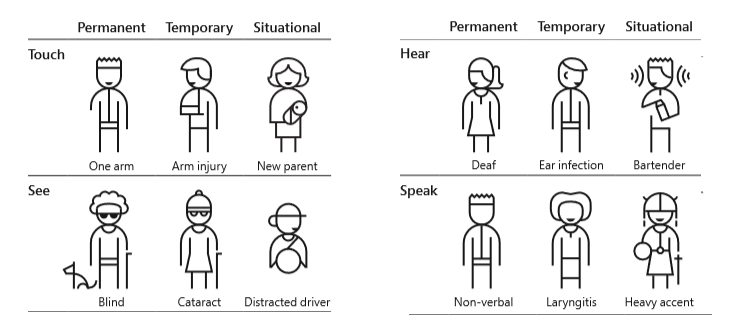
When inclusivity happens, we invite more people to experience our design. Let's say we design for someone who can only use one arm. By positioning the 'usage of one arm' as an attribute / characteristic, we open the doors to people (1) who permanently have one arm, (2) who have temporary arm injury, and (3) new parents which one arm is occupied carrying their baby. Thus more people benefit. Although only 26k people have permanent one arm, there are 13 million with temporary one arm due to injury, plus another 8 million parents with only one arm available because of their situation (based on US Census Bureau).
This is what is called Persona Spectrum, to understand our target audience based on permanent, temporary, or situational scenarios.

Banner
Write a comment