
Do Marketing and Sales Plan and Execute Booth Engagement Strategy Effectively?
-
Low trade show conversion rates frequently stem from a fundamental misalignment between marketing teams managing the budget and sales teams staffing the physical booth.
-
A recent LinkedIn poll indicates that approximately 60% of organizations suffer from a critical lack of cohesion between sales and marketing regarding exhibition goals and metrics.
-
Booth performance is often compromised by deploying junior Sales Development Representatives (SDRs) who lack the strategic depth required to engage senior-level decision-makers.
-
Industry experts recommend a balanced staffing framework that incorporates senior executives at the booth to build immediate trust, authority, and corporate credibility.
-
Maximizing event ROI requires shifting from random floor interactions to a shared-ownership model with clearly defined roles, synchronized objectives, and a seamless handoff process.
This is the summary based on The FEEL Podcast with Subhanjan Sarkar.
In many B2B tradeshows, exhibitors struggle with low conversion rates. A big reason behind this challenge lies in how booth engagement strategy is planned and executed.
During The FEEL: Future of Event Experience & Learning podcast, I asked Subhanjan Sarkar about this issue. His perspective highlights a fundamental problem: while marketing and sales coordinate, they are rarely fully aligned in process, roles, and responsibilities.
To maximize results, companies need a structured booth engagement strategy that complements a post-event follow-up plan, ensuring every lead is tracked and nurtured after the exhibition.
When marketing manages the budget and booth setup but sales staffs the booth, misalignment is almost inevitable. The transition between departments often becomes messy, leaving gaps in executing a successful booth engagement strategy.
Why Booth Engagement Strategy Often Fails Without Alignment
A recent LinkedIn poll revealed that around 60% of respondents rarely see marketing and sales working closely to align, articulate, and measure exhibition goals.
This lack of cohesion impacts the effectiveness of any booth engagement strategy. Marketing may focus on lead generation, while sales is pressured to close deals. Without shared ownership of the visitor journey, neither side fully leverages the booth opportunity.
Implementing a clear booth engagement strategy ensures that every visitor interaction is meaningful and aligned with measurable objectives.
Who Should Execute Booth Engagement Strategy at Exhibitions?
The most experienced salespeople are often not at the booth. Junior SDRs (Sales Development Representatives) handle the interactions, which can limit meaningful engagement with senior prospects.
Industry leaders like Julius Solaris suggest that senior executives should sometimes be present to maximize trust and credibility. Knowing when and how to deploy senior staff is a key part of optimizing your booth engagement strategy.
How to Improve Booth Engagement Strategy with Sales-Marketing Cohesion
To strengthen a booth engagement strategy, companies should:
- Define clear roles and responsibilities between marketing and sales.
- Align on measurable goals for before, during, and after the exhibition.
- Ensure follow-up processes are tracked and executed without gaps.
- Place the right people at the booth, combining authority with engagement skills.
Face-to-face interaction is your most valuable chance to build trust. Rushing conversations or delegating them to underprepared staff can waste these opportunities.
Applying a strong booth engagement strategy maximizes ROI and post-event lead conversion.
Closing Thoughts
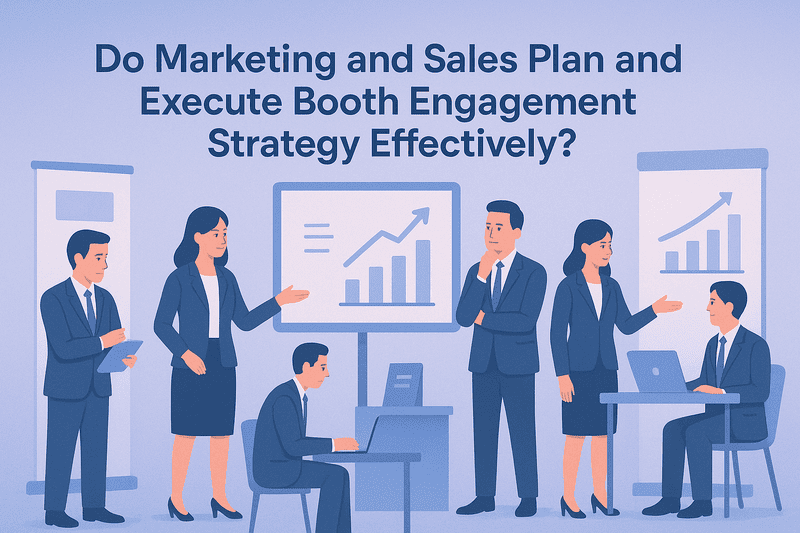
A winning booth engagement strategy is about more than flashy designs or giveaways. It's about building relationships, creating trust, and driving conversions. Align marketing and sales, and you'll unlock the full potential of your exhibition presence.
Even the best-aligned booth teams lose impact without a strong follow-up plan for booth leads.
Watch the conversation on The Feel Podcast.
Need personalized guidance on booth engagement strategy?
Follow Mike Gunawan on Linkedin.

Frequently Asked Questions
Q1: Why do many B2B trade show exhibitors suffer from low conversion rates despite high booth traffic?Low conversion rates happen because marketing and sales departments operate in silos rather than executing a unified booth engagement strategy. Marketing typically focuses on top-of-funnel lead volume and aesthetics, while sales faces pressure to close deals immediately, creating a disconnected visitor experience where leads are poorly qualified on-site and neglected post-event.
Q2: How does operational misalignment between sales and marketing teams negatively impact live booth engagement?When sales and marketing are misaligned, there is no shared ownership of the attendee's on-site journey, leaving significant gaps in lead qualification and messaging. Because nearly 60% of organizations fail to co-develop or measure trade show objectives, booth staff often rely on generic pitches instead of context-rich conversations that match the specific buyer intent of passing prospects.
Q3: Who should ideally staff a B2B exhibition booth to maximize credibility with high-value decision-makers?While junior SDRs can manage initial greeting and basic lead filtering, an optimal booth strategy requires the calculated deployment of senior executives and technical subject matter experts. Senior prospects want to engage with peers who possess decision-making authority and deep industry knowledge, making the presence of leadership essential for establishing immediate corporate trust.
Q4: What specific operational steps can companies take to build stronger sales-marketing cohesion before a trade show?Companies must explicitly define roles, responsibilities, and key performance indicators (KPIs) for both departments well before the exhibition doors open. This involves aligning on what constitutes a qualified lead, setting unified goals for every stage of the event lifecycle, establishing a clear protocol for on-site staff, and designing a bulletproof data-tracking pipeline for post-show handoffs.
Q5: Why is face-to-face interaction at an exhibition booth considered a critical window for pipeline acceleration?Face-to-face interaction is uniquely valuable because it offers a rare, high-trust environment to bypass digital gatekeepers and uncover complex buyer pain points through authentic human connection. Rushing these high-value conversations or leaving them to underprepared staff squanders the immense financial investment of the event, whereas a structured engagement strategy transforms casual floor visits into qualified corporate relationships.
Main Article
Related Articles
Banner

Write a comment