
Is Poor Trade Show Booth Staff Etiquette Killing Your ROI
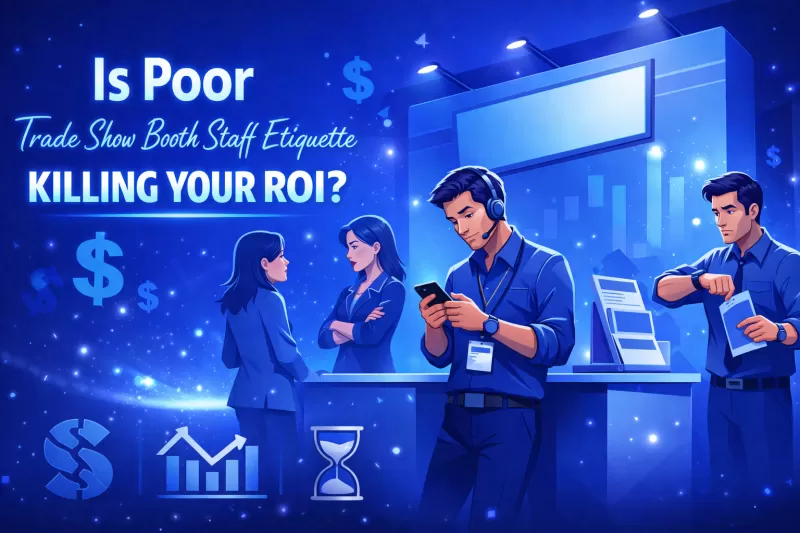
- Behavioral ROI: High-impact trade show booth staff etiquette acts as the primary driver for turning passive passerby into qualified business opportunities.
- The Guard Trap: Shifting from a "booth guard" perimeter mentality to 5-star hospitality standards instantly increases your booth's organic attraction rate.
- Time Poverty: Visitors only have 10-15 minutes per stop; your team must deliver a "peeled onion" messaging strategy to respect their limited schedule.
- The 95/5 Reality: Since 95% of attendees are out-of-market, staff should focus on building trust-based memory equity rather than forced immediate sales.
- Deep Qualification: Effective engagement moves beyond simple badge scanning to filter for authority, specific challenges, and actual procurement budget.
You’ve seen it at every major B2B exhibition. A beautifully designed booth, expensive lighting, and a staff of four standing in a huddle, scrolling through their phones.
They aren't exhibitors; they are patrol guards. They are inadvertently protecting the perimeter of your booth from the very people you paid thousands of dollars to meet.
This "booth guard" mentality is the silent killer of event ROI. It creates a psychological barrier that even the most innovative product display cannot overcome.
Why Your Average Trade Show Attraction Rate Is Lower Than Ten Percent
Most B2B exhibitors suffer from a dismal attraction rate because their staff ignores the fundamental hospitality standards of the 5-star hotel industry.
If your team stands behind a counter or gathers in a group, they signal to the visitor that the booth is a closed ecosystem, not a welcoming space.
Breaking the Patrol Guard Mentality at the Booth Perimeter
The perimeter of your booth is a psychological threshold. When staff stand right at the edge with crossed arms, they act as "guards" rather than facilitators.
Visitors fear being trapped in a high-pressure sales pitch. Your staff must learn to stand open, smile, and greet first—much like a Marriott receptionist.
The Hospitality Industry Secret to Welcoming High-Value Visitors
True engagement starts with body language. A simple smile and an active stance can shift your booth from a "product warehouse" to an "inviting destination."
By adopting a hospitality-first approach, you lower the visitor's defense mechanism. This is the only way to move them from the aisle into a meaningful conversation.
The B2B Exhibition Booth Design Strategy That Powers Staff Success
Staff etiquette doesn't exist in a vacuum; it is part of a broader system that includes your physical environment and messaging clarity.
If your booth design is cluttered, your staff will spend the first five minutes of every conversation just explaining what the company actually does.
Creating a 3-7 Second Message for Immediate Clarity
A visitor decides whether to stop or keep walking in about seven seconds. Your booth must communicate its core value proposition within that window.
When the design handles the "what," your staff is free to handle the "why" and the "how," leading to much higher quality engagement.
Why Plastering Product Catalogues on Backdrops Kills Conversations
Visual vomit is a common mistake. Plastering every technical detail on a backdrop overwhelms the visitor and leaves the staff with nothing to reveal.
As part of a broader system, your booth should act as a curiosity engine. It should invite the visitor to "peel the onion" layer by layer.
Note: Are your event efforts feeling like a cost center? Let’s audit your strategy to ensure your staff and booth are engineered for maximum conversion. Book FREE consultation here.
Trade Show Psychology for Exhibitors Who Want to Be Memorable
B2B trade show psychology suggests that pushing for a "marriage" (a sale) during the first "date" (the booth visit) is the fastest way to get ghosted.
With 95% of buyers being out-of-market, your staff’s primary goal is to be the most helpful and memorable person the visitor meets that day.
The Date vs Marriage Analogy for B2B Sales Conversations
Many exhibitors pester their visitors with sales questions too early. This pressure causes the prospect to misrepresent themselves or provide fake contact info.
Instead, treat the interaction as a discovery session. Focus on listening to their challenges rather than "vomiting" your product knowledge all at once.
Peeling the Onion via Succinct Key Messaging
Succinctness is a sign of expertise. Because visitors visit 20-30 booths a day, they only have about 15 minutes to spare for your entire demonstration.
Deliver your message in layers. Start with the most relevant insight and only go deeper once the visitor validates their interest with a question.
Effective Trade Show Product Demonstrations Without Information Overload
An effective demonstration is not a lecture; it is a validation of the prospect's pain points through the lens of your solution.
Most staff fail because they focus on features. High-performing staff focus on the mechanism of the solution and how it solves a specific user frustration.
How to Explain USPs Without Vomiting Knowledge
Stop explaining and start demonstrating. Use the "pause and validate" technique: explain a feature, then ask, "Are you currently experiencing this issue?"
This turns a monologue into a dialogue. It ensures the visitor remains engaged and prevents the "glazed eyes" look that signals a lost lead.
The Power of Pausing and Validating the Prospect’s Experience
If you don't pause, you can't listen. And if you don't listen, you can't qualify. Your staff must be trained to value the prospect's input over their own script.
This transparency builds trust. Like Jeff Bezos’s Amazon reviews, giving the full truth builds long-term loyalty that is more profitable than a short-term scan.
Why Trade Show Leads Ghost Sales and How to Qualify Better
The reason sales teams hate trade show leads is usually a lack of qualification at the booth. A badge scan is not a lead; it is just a contact.
If your staff doesn't qualify for intent, the sales team will eventually stop following up, rendering the entire exhibition a waste of marketing budget.
Moving Beyond the Badge Scan to Deep Intent Filtering
True qualification involves understanding the visitor's authority, their specific timeline, and how they are currently coping with the problem you solve.
Ask about their DIY solutions or competitor usage. This data is the "gold" that makes a lead worth the sales team's time for a follow-up.
Using Commitment Forms to Secure the Next Downstream Touchpoint
Don't just give away a generic brochure. Offer relevant, curated content and ask how and when they would like to be contacted for a follow-up.
This creates a micro-commitment. A visitor who agrees to a specific time for a call is ten times more likely to convert than one who just takes a flyer.
Want to dive deeper into the environmental psychology of memorable booth experiences? Listen to our latest episode of The FEEL Podcast.

Frequently Asked Questions
Q1: What are the most important trade show booth staff etiquette rules?The most critical rules include maintaining an open and welcoming body language, avoiding "staff huddles" or phone usage, and greeting visitors before they reach the booth perimeter. Staff should act as facilitators who listen more than they speak. Respecting the visitor's "time poverty" by being succinct is also a mandatory behavioral standard for high-stakes B2B environments.
Q2: How do I improve my booth's attraction rate?Attraction rate is improved by combining clear, 3-second booth messaging with proactive staff engagement. When staff move away from behind counters and stand near the aisle with a welcoming smile, the psychological "friction" of entering the booth is reduced. Training staff to use the hospitality industry's reception standards can increase attraction rates significantly compared to the average 10% seen at most shows.
Q3: How should staff qualify leads at a B2B exhibition?Qualification should go beyond job titles. Staff need to uncover the prospect's specific challenges, their current solutions (DIY or competitors), their decision-making authority, and their purchase timeline. Using a structured qualification form or "commitment form" ensures that only high-intent leads are passed to the sales team, reducing the likelihood of "lead ghosting."
Q4: Why do visitors ghost sales reps after a trade show?Ghosting happens when the booth interaction was transactional rather than relational. If a staff member pestered the visitor for a sale or scanned their badge without providing real value, the visitor feels no obligation to follow up. By focusing on "helping the customer make a better decision" rather than just collecting a contact, you build the trust necessary for a successful post-show engagement.
Q5: What is the "peeling the onion" communication strategy?This strategy involves delivering information in succinct, manageable layers. Instead of explaining every product feature at once, staff provide a high-level key message to capture interest. As the visitor asks questions and moves deeper into the booth, the staff "peels" back more technical layers. This respects the visitor's 10-15 minute time limit and keeps them curious for more information.
Banner
Write a comment