
What Should You Say in the First 10 Seconds at a Trade Show?
You are standing at the edge of your booth as a group of three decision-makers walks toward you. They are moving with purpose, eyes fixed on the path ahead, deep in conversation with each other. Even though they glance at your display for a split second, their momentum doesn't break.
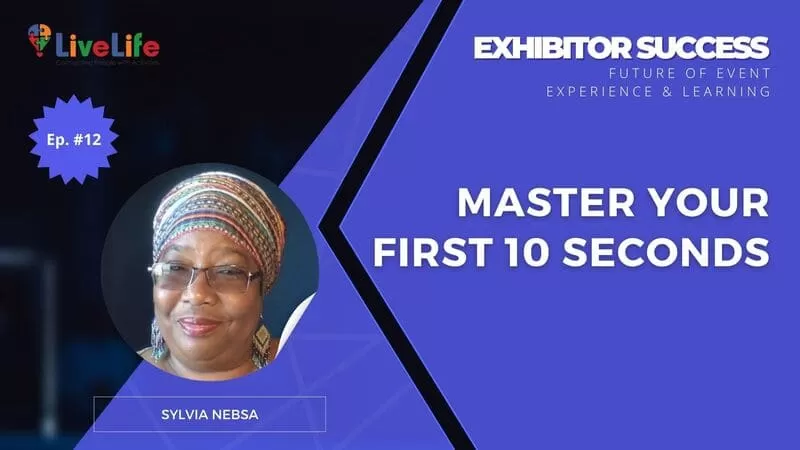
This is the summary based on The FEEL Podcast with Sylvia Nebsa.
In that moment, you have roughly ten seconds to stop them.
If you want to hear this moment explained directly, including the subtle vocal tonality and body language required to command the aisle without being aggressive, you can listen to the strategic breakdown at The FEEL Podcast.
Most exhibitors panic. They default to being a "shopkeeper" instead of an "engagement professional." They say something generic like, "How is your morning going?" or "Can I tell you more about our company?" By the time the question is out, the group is already five booths down the aisle.
Understanding exactly what should you say in the first 10 seconds at a trade show is the single most important skill for tripling your sales results. If you can't break their momentum and hook their curiosity, the rest of your sales framework never even gets a chance to work.
Why the First 10 Seconds Determine Your ROI
The trade show floor is a high-sensory environment where every booth begins to blur together. Visitors might pass 100 stands in a single day. To protect their time and energy, they develop "sales filters." They stop listening to anyone who sounds like a typical vendor.
The biggest trade show sales mistakes happen in this opening window. Most people don't think about their opening; they simply imitate what they see others doing. They act like retail clerks, waiting for the customer to come to them.
But at a B2B event, you aren't waiting for a shopper; you are intercepting a professional with a specific mission. If your first sentence sounds like every other person in the hall, you become invisible. To stand out, you have to use unconventional strategies that bypass their filters and pique their curiosity.
Stopping them is only the first step. A strong trade show booth experience is what rewards their decision to pause and keeps them engaged.
The Hidden Cost of Imitating "Shopkeepers"
When booth staff act like shopkeepers, they focus on being polite rather than being effective. Politeness is important, but "Can I help you?" is a momentum-killer. It invites a "No" and gives the visitor a socially acceptable reason to keep walking.
The hidden cost of these conversational errors is a booth that feels stagnant. Even if your product is revolutionary, it won't matter if your opening line is boring. You lose the chance to start a transaction because you didn't know how to hook visitors at a trade show booth before they crossed your "invisible line."
Unconventional Strategies to Hook Visitors Immediately
To successfully stop someone who is mid-stride, you must do something different. You need to transition from "just showing" to "professionally engaging."
1. The Pattern-Interrupt Question
Instead of a greeting, lead with a question that forces the brain to stop its current train of thought. This should be about a specific challenge or an interesting visual element in your booth.
- Standard: "How are you today?"
- Unconventional: "Are you currently dealing with [specific industry pain point] like everyone else we've talked to today?"
2. The Direct Visual Call-Out
If a visitor is looking at your booth but still walking, call out what they are seeing.
- "That's our [product name]—it actually solved [X problem] for [Company Y] last month. Have you seen anything like it?"
3. The Curiosity Hook
Start with a statement that demands a follow-up. Curiosity is the tool we use to both start and end the engagement.
- "We’ve found a way to cut [Industry Process] time in half, and most people here don't believe it until they see the demo. Want to be the judge?"
If you are questioning whether your current opening lines are strong enough to carry your brand's authority, Mike Gunawan is available for a reflection or a strategic exchange on how to sharpen your floor-level engagement.
How This Connects to the Bigger System
Knowing what should you say in the first 10 seconds at a trade show is the gateway to a much larger, proven methodology. Once you have hooked their curiosity and stopped their momentum, you move into the "Show, Ask, and Tell" system.
This works best when combined with a full framework where your opening line is just the first step in a turnkey process. By having a specific set of unconventional things to say and do, you remove the need for your sales reps to improvise or "think too hard" during an exhausting event.
When every team member is trained as a customer engagement professional, you move from "hoping" for leads to "systematically generating" them. You stop being part of the crowd and start being the booth that everyone remembers.

Frequently Asked Questions
Q1: What is the single biggest mistake people make in the first 10 seconds?The biggest mistake is asking a closed-ended, "safe" question like "Can I help you?" or "Are you enjoying the show?" These questions require zero engagement from the visitor and allow them to keep walking without a second thought. They are "shopkeeper" questions that kill the opportunity for a real B2B transaction before it begins.
Q2: How do you stop people from walking past your booth if they are in a group?Stopping a group is harder because they have collective momentum. You must address the group as a whole or use a high-impact visual "Show" to grab their collective attention. A pattern-interrupt question works well here because it forces the group to pause their internal conversation to process what you just said.
Q3: Does being "unconventional" mean being aggressive?Not at all. Aggression pushes people away. Unconventional engagement pulls them in through curiosity. It’s about saying something that is so relevant or interesting that the visitor wants to stop. It is a service-oriented approach that respects their time by getting straight to the value you provide.
Q4: How can I train my booth staff to use these opening lines naturally?Training should focus on a "turnkey" approach. Provide your staff with three specific, proven opening lines that align with your booth’s "Show" element. Use roleplay to ensure the words roll off their tongue automatically. The goal is to make the engagement so practiced that it feels authentic and high-energy even at the end of a long day.
Q5: Why is curiosity so important in the first 10 seconds?Curiosity is the only thing strong enough to break a visitor's momentum. They are on a mission to see the whole show; your job is to give them a "cliffhanger"—a reason to believe that stopping at your booth is more valuable than continuing down the aisle. If you trigger curiosity immediately, you bypass their sales filters.
Main Article

Related Articles
Banner
Write a comment