
How To Start A Booth Conversation Before Demo (the Connection Framework)
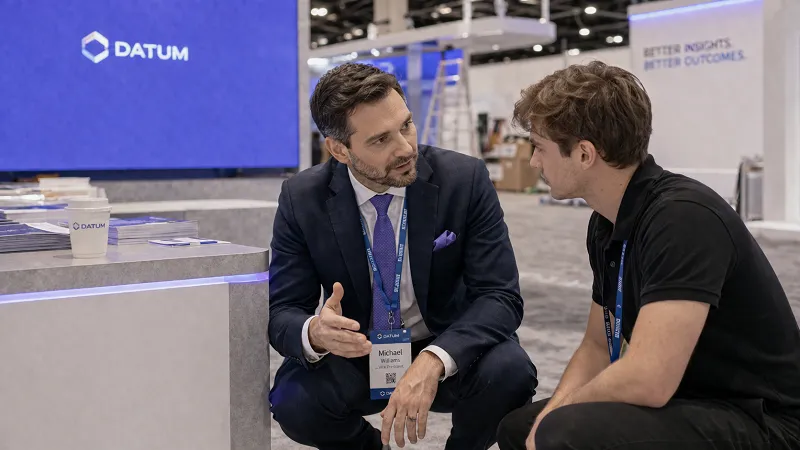
- The fastest way to lose a trade show visitor is to shake their hand and drag them straight to the screen, because with every second of the deep dive without connection, they quietly check out.
- Borrowing Donald Miller's Story Brand thinking, your visitor is the hero and you are the guide, so the most memorable story says "I know you, I'm up against the same obstacles" long before it ever mentions your dashboard.
- Win the right to demo by trading data-dumping for a shared mutual benefit, so the visitor leans in and says "please, help me with this" instead of drifting toward the booth next door.
This is the summary based on The FEEL Podcast with Steve Multer.
There's a specific moment where most booth interactions go sideways, and it happens faster than people expect. You bring a visitor over to the demo, and you start to dump things on them. You deep dive.
What Steve describes is that with every second of that deep dive you go further without connecting, your audience checks out. The clarity you thought you were providing becomes the very thing pushing them away.
The problem was never your product or your data. The problem is the sequence. When you jump straight into a walkthrough, you're quietly asking the visitor to do all the heavy lifting themselves, to figure out on their own why any of this matters to their day, their team, their specific headache.
Most people won't do that work for you in a noisy hall. They'll just drift toward a booth that seems to understand them without making them translate.
This is why a forgettable experience feels the way it does. A forgettable engagement in a conference or a trade show setting is one where none of the real connection ever happens. You shook their hand, you showed them the screen, and yet nothing landed.
The demo showed what your product does, but it never established what your product means to that one person standing right in front of you. That gap in alignment is exactly where the engagement leaks out.
And here's the uncomfortable part. This one broken moment isn't really a scripting problem. It's a symptom of a much bigger question about how to staff and run a trade show booth that drives ROI, because everything on the floor traces back to whether your people know their actual role before the doors open.
Get that foundation wrong, and no clever opening line will save you. So let's start where the real fix begins.
How to Make Booth Conversations About the Visitor, Not the Product
Steve points to a mentor of his in this industry, Donald Miller, whose book Building a Story Brand shapes how he approaches all of this.
Miller's argument is that whoever you're speaking with in that moment, whether it's an audience of one or an audience of twenty-five thousand, needs you to play a clear and compelling role in their lives.
They're investing in you to help them fulfill the role they already see themselves inhabiting. That's a subtle but important shift in where the story points.
So the most memorable brand story you can tell doesn't center on you, your product, or your company. It centers on that audience, the person or the people right in front of you. The best outbound messaging actually moves somebody.
It motivates the customer, the partner, even the media analyst tracking what you do. Memorable comes from being accessible and being recognizable, and that only happens when you refine the conversation until the visitor is clearly the hero rather than a spectator to your pitch.
Making that shift takes a little intentional restructuring of your booth strategy, but it isn't complicated. The whole point is to make the visitor feel seen before you ever ask them to look at anything on a screen.
The Script Pivot That Signals "I Know You"
Here's what recognizable actually sounds like in practice. Steve frames the ideal story as one that quietly says: I know you, I understand you, we speak the same language.
I recognize who you are, what drives you, and what you are up against, because I'm up against the same obstacles and challenges. We're in this thing together, so let's partner so I can help you get to the heart of your problem.
When you tell that kind of story, the visitor is right there in the palm of your hands. They start nodding, and they say, "Yeah, please get in there. Help me. I know you, I trust you, you seem credible, you're out here to help me. I want in."
That's the moment you've earned. Notice it has nothing to do with your dashboard yet, check this? It's pure shared identity, and that's the thing that makes everything after it actually stick.
What Makes a Booth Story Memorable in a Noisy Exhibit Hall
Competition on the floor is genuinely fierce and the room is loud, with booths and competitors crowding in from every direction. In that kind of environment, being accessible beats sounding sophisticated every single time.
If a visitor has to work too hard to understand you, they'll move on before you finish your sentence. Being recognizable as a peer carries you further than sounding impressively high-tech.
The way through is what Steve calls a shared mutual benefit. You're not just showing someone software, you're pulling them into a narrative where their specific problem gets solved in partnership with you.
When the visitor reaches the point of saying "please, help me with this," you've hit the real goal of a booth conversation. That's the engagement that turns into a demo they genuinely want, rather than one they politely endure on the way out.
So before your next show, it's worth sitting with one honest question. In those first moments at the booth, are you moving the person, or just moving the mouse? The answer usually explains everything about who leans in and who quietly slips toward the exit.

Frequently Asked Questions
Q1: Why do people check out during a booth demo?Because you're overloading them with data before connecting, and as Steve Multer explains, with every second of that deep dive you go further without connecting, your audience mentally checks out and then physically leaves, especially in a noisy hall where competitors are crowding in all around.
Q2: How do I make a booth conversation about the visitor instead of my product?Apply Donald Miller's Story Brand idea from Building a Story Brand, where the visitor is the hero investing in you to fulfill the role they see themselves inhabiting, so your story centers on them, not your product or company, and quietly signals "I know you, I understand you, we speak the same language."
Q3: What actually makes a booth story memorable in a loud exhibit hall?Being accessible and recognizable as a peer beats sounding high-tech, so you involve the visitor in a shared mutual benefit until they nod and say "please, help me with this," which is the real moment you've earned the demo.

Banner
Write a comment