
Should I Invest in Booth Design or Booth Staff? The ROI Truth
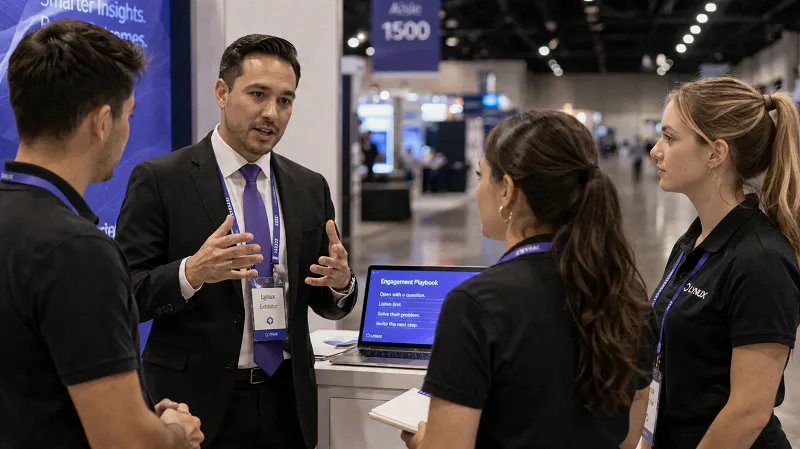
- The empty high-tech booth isn't a design problem, it's a priority problem — a phenomenal person on a bare stage will always out-earn a mediocre one wrapped in truss and LED ribbon.
- When two budgets collide, Steve Multer buys the human 100% of the time and 300% the rest, because architecture can't pivot to an attendee's pain point but a trained storyteller can.
- Sound, touch, and visual are strongest when they're people, not machines — great tech enhances human connection, it never replaces it, so the rare dollars belong with the actors.
This is the summary based on The FEEL Podcast with Steve Multer.
If you want real clarity on what makes a booth engaging, you have to stop staring at the architecture. Engagement isn't a visual metric. It's an emotional one, and the entire game is that quiet second when an attendee shifts from a walk-by to a stop-in.
No amount of LED wall square footage produces that moment on its own, which is why the most expensive booth on the floor can still stand empty.
Here's the picture Steve keeps returning to, and it quietly reframes the whole budget question. Imagine a phenomenal actor on a bare stage with nothing but a chair. That performer can hold a room for a long stretch.
Now picture a mediocre actor surrounded by an exciting, compelling set — pyrotechnics, a revolving stage, a digital ribbon flashing overhead — and watch how fast the attention drains away. The stage was never the thing.
The person on it always was. Your booth design is the stage, and your booth staff are the actors. (check this?) That single shift in framing is really the whole conversation about how to staff and run a trade show nooth that drives ROI — it isn't a design problem, it's a people problem wearing a design costume.
Put it that way, and the spending decision starts to look very different from how it looked in that leadership meeting.
So where does the money actually create engagement? It lives in a hierarchy, and most booths build it upside down:
- Human Connection sits at the top. It's the sense of connection only a real person can create, the one element in your entire booth that can pivot, listen, and respond to a specific pain point in real time.
- Inspiration comes next. It's the story of how your product solves a high-stakes problem, the part that makes someone lean in instead of glancing past.
- Information sits at the bottom. The specs, the data, the how-to. It matters, but it's the floor, not the ceiling.
Most booths flip this pyramid completely. They lead with information plastered across the back wall, they hope a video delivers the inspiration, and they treat the human standing there as an afterthought.
To win, you flip it back and pour your rare dollars into where the connection actually happens. When was the last time you bought something meaningful from a museum exhibit rather than from a person who understood what you needed?
How to Engage the 5 Senses at a Trade Show Booth Without Breaking the Bank
There's a misconception worth killing early, because it drains budgets fast. People assume engaging the five senses at a booth demands serious capital — great sound quality, a beautiful sleek space, a phenomenal video running on the wall behind you, a rotating truss overhead with a digital ribbon carrying your message.
Steve doesn't dismiss any of it. He calls all of those elements genuinely terrific, and he means it.
But here's the alignment most teams miss, and it's the heart of his answer. Those elements are enhancers, never replacements, and they only earn their cost if you have the budget to do both the tech and the phenomenal people who tell the story face to face, human to human.
Almost nobody has that budget. So before you spend on machines, look hard at what your staff already delivers across those same senses, because the human version is usually the stronger one anyway.
If we're not telling the right story in that environment, the graphics on the back wall and that video and that lighting and that music and those giveaways are not going to replace phenomenal human connection. They enhance it. They can't replace it.
Look at what each sense actually experiences at the point of contact, and you start to refine the spend down to what matters:
- Sound isn't the roar of a speaker. It's the confident, professional tone of a storyteller who knows exactly where the conversation is going.
- Touch isn't a cold screen. It's the physical handover of a high-quality, tactile sample placed straight into someone's hands.
- Visual isn't a distracting LED ribbon. It's the eye contact and the body language of an expert who is genuinely listening.
This is the bare-stage principle in practice. Use minimal, clean design with good lighting to strip out the noise, and let the human-to-human story take center stage. A cluttered high-tech environment often works against you, because it competes with the very person you need the attendee to notice.
The 300% Rule: Why You Buy a Person Over a Product
When you are genuinely forced to choose between two budgets, Steve's answer arrives without a hedge, and he offers it knowing it might land as controversial with part of the audience.
Choose the humans 100% of the time — and 300% the rest of the time. He says it as a deliberate correction to an industry that stays permanently distracted by the next big thing in event tech.
The reasoning is grounded in something every event leader already feels in their gut. Nobody is getting more money from leadership, whether the company is a small one or a massive global corporation.
You do a phenomenal job one year, and the next year they expect an equally phenomenal job at 30% less budget. As those rare dollars get cut and cut again, deciding where they work best becomes the entire job — and passive architecture can't pivot, while a trained person can.
That's the strategy underneath the whole rule, and it holds across the pre-show planning, the in-show execution, and the post-show follow-up that decides whether any of it converted.
Training Your Actors
If you commit to people, you can't just send the sales team out and hope for the best. That's the pre-show work most teams skip, and it's quietly where exhibitor success is won or lost.
Your staff have to be trained as storytellers, which means handing them a real framework for the moment an attendee actually stops walking. They need to identify the character — the attendee — and the conflict they walked in carrying, which is the pain point.
They need to deliver the climax, the solution, fast. And they need to bridge the gap between words seen on a back wall and a personal connection felt toward the brand.
Scaling Down Without Scaling Down Impact
When the 30% cut lands, resist the obvious move. Don't build a cheap version of a high-tech booth, because it will look precisely like what it is — a budget compromise that fools no one. Lean into the bare stage instead.
Put two or three phenomenal, high-energy, expert staffers into a clean professional space, and pour the rest of the budget into their ability to facilitate conversation. A high-tech booth that fails to pull people in is a sunk cost.
A bare-stage booth that facilitates fifty high-quality human-to-human connections is a profit center. Which one do you actually want to carry back into that leadership meeting next year?
For more on human-centric event strategy and telling your brand's story across the trade show floor, the full conversation with Steve Multer lives on The FEEL Podcast.

Frequently Asked Questions
Q1: Should I invest in booth design or booth staff when my budget gets cut?Staff, almost every time. Steve Multer's rule is to choose the humans 100% of the time and 300% of the time when forced to pick, because very few teams can afford both the tech and the people, and passive architecture can't respond to an attendee in real time the way a trained person can.
Q2: Can't high-tech elements like video walls and rotating trusses replace booth staff?No. Steve is direct that graphics, video, lighting, music, and giveaways enhance human connection but never replace it. If you're not telling the right story face to face, the tech becomes an expensive backdrop nobody stops for.
Q3: How do I engage the five senses at a booth without a huge budget?Look at your staff before your machines. Sound becomes the confident tone of a storyteller, touch becomes the handover of a quality sample, and visual becomes the eye contact of an expert who's actually listening — a clean bare-stage space with good lighting lets those human signals carry the work.

Banner
Write a comment