
Does Knowing How To Transition From Single Events To Portfolios Scale Roi
- The Strategic Shift: Mastering how to transition from single events to portfolios is the key to moving from execution to high-level business strategy.
- The Workload Paradox: Event Portfolio Management (EPM) actually reduces team burnout by eliminating redundant tasks and providing absolute organizational clarity.
- The Tire Metaphor: Measuring a single event in isolation is like checking one car tire while the rest of the vehicle has a flat or a missing engine.
- Funnel Alignment: True ROI comes from balancing high-cost awareness activations with targeted conversion events across the entire sales funnel.
- Synergy Math: A cohesive portfolio ensures that 1+1 equals 5 by creating momentum that individual, disconnected events simply cannot replicate.
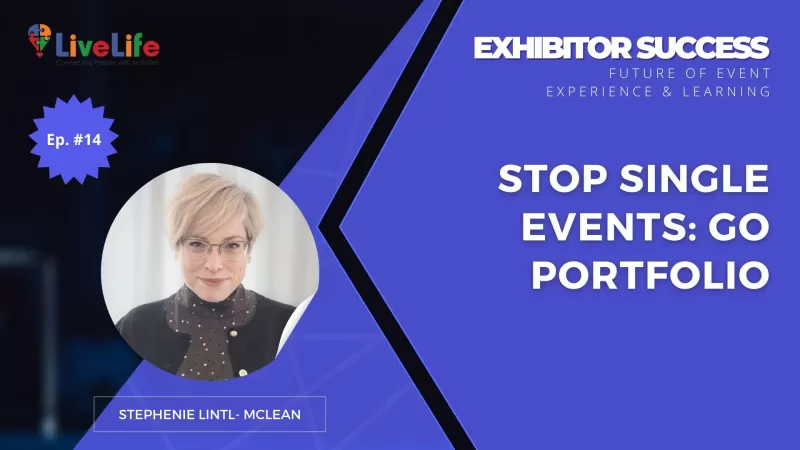
This is the summary based on The FEEL Podcast with Stephenie Lintl-McLean.
Most event managers are trapped on a high-speed hamster wheel. You plan, you execute, you breathe for a second, and then you start the cycle all over again.
This "execution-first" mindset feels productive, but it is often a mask for strategic drift. Without a bird's-eye view, you are simply moving parts without knowing if the machine is actually traveling toward the destination.
The breakthrough happens when you stop looking at your calendar and start looking at your map. Understanding how to transition from single events to portfolios is the difference between being a cost center and a revenue driver.
Why event portfolio management reduces planning workload
A common misconception is that managing a portfolio is "more work" than managing individual events. In reality, the opposite is true. Complexity arises from a lack of direction, not a high volume of tasks.
How moving from execution to clarity eliminates redundant tasks
When you operate in silos, every event is a "start from scratch" project. You reinvent the wheel for every booth, every keynote, and every lead capture process.
Event Portfolio Management (EPM) provides a blueprint that allows you to reuse strategic assets. By gaining clarity on the "why," you stop wasting time on the "what" that doesn't move the needle.
Why seeing the big picture simplifies decision-making for event teams
Clarity is the most expensive commodity in business. When your team knows exactly how an event fits into the annual objective, the "no" becomes as easy as the "yes."
You stop debating minor logistics because the strategic framework dictates the requirements. This shift reduces the mental load on your team and speeds up the approval process.
How to align events with business goals through strategic synergy
If your events are not talking to each other, you are leaving money on the table. Synergy is the art of making sure your awareness efforts feed your conversion efforts.
Why cohesiveness creates more value than individual event silos
In a siloed model, 1+1 equals 2. In a portfolio model, 1+1 equals 5. This happens because the momentum from a large trade show is captured and funneled into a targeted executive round table.
Cohesiveness ensures that the brand narrative is consistent. The prospect doesn't feel like they are meeting a new company at every touchpoint; they feel like they are progressing through a journey.
If you are struggling to find this synergy within your current marketing stack, a strategic audit can help. book Free consultation to align your event portfolio with your revenue goals.
How to identify if your current events are working toward the same objective
Audit your last six months of events. If the KPIs for your top-of-funnel awareness event are the same as your bottom-of-funnel VIP dinner, you have a misalignment problem.
Every event must have a specific "job to do" within the broader system. If an event doesn't have a clear successor in the journey, it is a dead end for your data.
Why the car tire metaphor explains the failure of single event metrics
Measuring the success of a single event in isolation is a diagnostic trap. It provides a localized data point while ignoring the systemic health of the business.
Why looking at a single event lacks the context of the business vehicle
Imagine looking at a single car tire. It looks perfectly inflated and the tread is deep. You might conclude the car is in great shape.
But if the other three tires are flat and the engine is missing, that one "successful" tire is useless. Single event ROI is that one tire—it looks good on paper, but the business isn't moving.
How to spot the "flat tires" in your event strategy through a bird's-eye view
EPM allows you to see which events are underperforming relative to the whole. Perhaps your awareness events are "inflated" with leads, but your conversion events are "flat."
By stepping back, you can see that the problem isn't the individual event's execution. The problem is the lack of a bridge between the two stages of the funnel.
How to measure event ROI across the funnel for maximum impact
To truly understand how to measure event ROI across the funnel, you must accept that not all ROI is financial. Some ROI is educational, and some is relational.
Why awareness events and conversion events require different tracking systems
An awareness event should be measured by reach, brand sentiment, and new entries into the database. Expecting immediate "closed-won" revenue from a trade show is a recipe for perceived failure.
Conversely, a conversion event should be measured by pipeline velocity and deal size. These require distinct tracking systems that talk to your CRM to show the full attribution path.
How to balance overspending in awareness versus underspending in conversion
Many brands overspend on "the big show" and leave nothing for the follow-up. They create massive awareness but have no mechanism to convert that interest into intent.
A balanced portfolio reallocates budget from the "loud" events to the "quiet" ones where the actual selling happens. This ensures a smooth flow of prospects from the top to the bottom of the funnel.
What dashboards and tracking systems are needed to see the full picture
You need a centralized dashboard that tracks a lead's journey across multiple events. This allows you to see the cumulative impact of your portfolio.
This data-backed approach moves you away from "gut feelings" about which events were "good" and toward a mathematical understanding of your marketing engine.
For more deep dives into the philosophy of event strategy, subscribe to The FEEL Podcast and join the conversation with industry leaders.

Frequently Asked Questions
Q1: What is the first step in transitioning from single events to a portfolio?The first step is a comprehensive audit of your current event calendar against your sales funnel. You must identify which events serve awareness, which serve consideration, and which serve conversion. Once you map these out, you can see the gaps where prospects are falling out of your journey.
Q2: Why does event portfolio management reduce planning workload?It reduces workload by creating repeatable frameworks and strategic clarity. Instead of starting every event from scratch, teams use a "portfolio playbook." This eliminates the need for constant high-level decision-making on minor details, as the overarching strategy already provides the answers.
Q3: How do you measure event ROI across the funnel for awareness events?Awareness ROI should be measured by "Cost Per Acquisition of Intent." This includes metrics like new lead generation, social media lift, and brand search volume. The goal is to prove that the event successfully fed the top of the funnel so that lower-funnel events have a pool of prospects to convert.
Q4: Why is the "car tire" metaphor important for stakeholders?It is a powerful way to explain to executives why a "successful" event might not be resulting in sales. It helps them understand that a single event is just one part of a complex machine. If the rest of the marketing and sales machine is broken, the event cannot fix it alone.
Q5: Can small teams implement event portfolio management?Yes, and they arguably should do so more than large teams. Because small teams have limited resources, they cannot afford to waste energy on "dead-end" events. EPM ensures that every ounce of effort contributes to a larger goal, making a small team's impact feel much larger.
Q6: What tools are essential for managing an event portfolio?You need a CRM (like HubSpot or Salesforce) that supports multi-touch attribution, an event management platform that integrates with that CRM, and a data visualization tool (like Tableau or Looker) to create a bird's-eye view dashboard of the entire funnel.
Main Article

Related Articles
Banner
Write a comment