
Why Is Trade Show Sales and Marketing Alignment Failing Your ROI
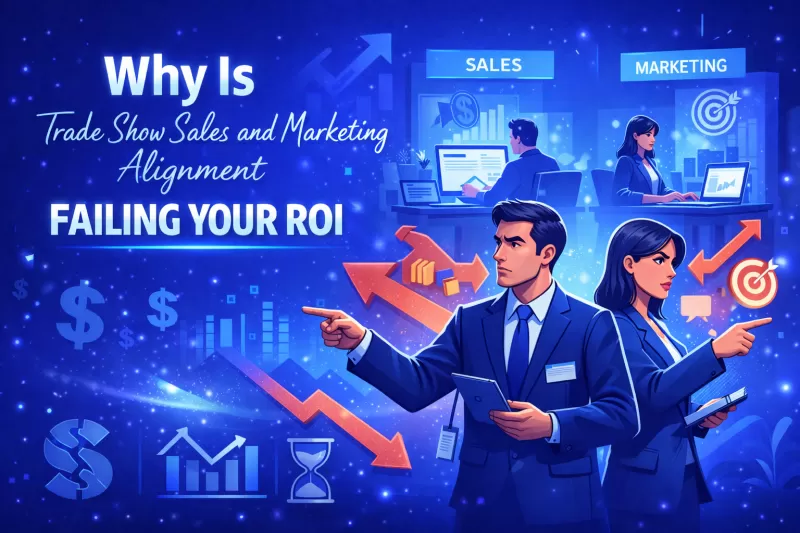
- The Alignment Gap: True trade show sales and marketing alignment prevents the "boss order" trap by rooting every exhibition in a validated business objective.
- Firmography Redefined: Focus on the visitor’s current situation and strategy rather than relying on deceptive and static job titles.
- Staffing ROI: Training your team to break psychological barriers can increase qualified leads by over 20% according to CEIR research.
- Succinct Messaging: You only have 3.2 seconds to capture attention before a prospect decides to keep walking or engage.
- Precision Nurturing: Shift from generic follow-up templates to personalized stakeholder responses to engage the 95% of out-of-market buyers.
Most B2B organizations treat trade shows like an isolated marketing expense. The "boss orders" the booth, marketing prints the brochures, and sales shows up to collect business cards.
This siloed approach is exactly why most exhibitors struggle with rising costs and irrelevant visitors. When the floor closes, sales ghosts the leads, and marketing can't prove ROI.
To fix this, you must treat the exhibition as a unified sales and marketing contract. If both teams aren't aligned before the crate opens, the investment is lost before the first visitor arrives.
How to Set Exhibition SMART Goals Examples That Sales Actually Values
Standard goals like "get more leads" are too vague to drive revenue. Marketing needs to know exactly how many convertible leads are required to justify the resource allocation.
Start by moving beyond competitor presence or special offers as a reason to exhibit. Collaborate with sales to determine if the goal is to accelerate existing deals or enter a new market.
There are four key areas to discuss with sales for alignment: lead volume, lead quality definitions, existing prospect invitations, and the specific "next step" for every captured lead.
Building a B2B Ideal Visitor Profile Beyond Standard Job Titles
Targeting visitors based solely on industry or company revenue is a surface-level strategy. This approach ignores the reality of how modern B2B decisions are actually made.
A job title in one company may carry massive influence, while the same title elsewhere has zero authority. You must map your B2B ideal visitor profile based on their current internal strategy.
Look at the "Situation & Strategy" firmography. Is the company currently expanding, or are they in a cost-cutting phase? This context determines if they are a high-priority target or a curious learner.
A Pre-show Promotion Strategy for Exhibitors to Drive Targeted Traffic
The organizer’s job is to get people to the hall, but your job is to get your target audience to your specific booth. Relying on the show app profile is a recipe for being ignored.
A high-performance pre-show promotion strategy for exhibitors involves creating a custom landing page. This allows you to track intent and offer a specific reason for a VIP visit.
Use your partner and sponsored media to drive traffic to this page weeks before the event. This warms the funnel and ensures your sales team's calendar is full before day one.
If you need to audit your current lead flow or align your teams, book FREE consultation to turn your trade show presence into a strategic revenue engine.
How to Attract Target Audience to Trade Show Booth Without Generic Giveaways
Irresistible freebies like ice cream might increase traffic, but they often attract the wrong crowd. Your goal is to design a booth that is easy to understand in a glance.
The "Patrol Guard" fallacy occurs when staff stand behind a reception counter facing visitors. This creates a physical and psychological barrier that stops prospects from entering.
Staff should move to the perimeter, smiling and giving off a welcoming vibe. Their booth staff roles and responsibilities are to engage, qualify, and interest—not just "guard" the brochures.
Using Trade Show Lead Qualification Questions to Filter for Intent
Visitors often misrepresent themselves to get what they want or simply to avoid a sales pitch. You need standardized trade show lead qualification questions to uncover the truth.
Ask about their specific challenges, how they are coping currently, their decision-making process, and their timeline. Don't just scan a badge and hope for the best.
This filtering process ensures that marketing only passes "rare gems" to sales. A busier booth is a failure if the visitors don't fit your sales team's roadmap or current capacity.
Executing Personalized Trade Show Follow Up for Better Conversion
According to Ehrenberg-Bass, 95% of buyers are out-of-market. Sending a generic follow-up template to everyone ignores their unique buying stages and specific pain points.
Effective, personalized trade show follow up requires segmenting leads by their stakeholder challenges. One attendee might need a technical whitepaper, while another needs a discovery call.
To hear more about the psychology behind memorable exhibition experiences, listen to the latest episodes of The FEEL Podcast.

Frequently Asked Questions
Q1: What are the most effective trade show lead qualification questions?The most effective questions move beyond "what do you do" and dive into "what are you solving." Ask: "What specific challenge brought you to this show?" followed by "How are you currently coping with that issue?" and "Who else in your organization is affected by this?" Finally, ask about their timeline and budget to determine if they are in the 5% of in-market buyers or the 95% who need long-term nurturing.
Q2: How do you create a B2B ideal visitor profile for an exhibition?Instead of just company size or industry, focus on firmography related to their current situation. Are they undergoing a digital transformation? Are they expanding into Southeast Asia? Align this with job roles rather than just titles. An "influencer" is often more accessible than the final decision-maker. Mapping these strategic indicators ensures your booth staff knows exactly who to prioritize during high-traffic periods.
Q3: Why is marketing and sales alignment so critical for trade show ROI?Without alignment, marketing focuses on lead quantity to show "success," while sales focuses on lead quality to close deals. This disconnect results in marketing passing unqualified leads that sales eventually ignores. Alignment ensures both teams agree on the definition of a "lead" and the SMART goals of the event, turning the trade show from a cost center into a pipeline accelerator.
Q4: What is a pre-show promotion strategy for exhibitors that actually works?A successful strategy involves taking ownership of your own traffic. Instead of relying on the organizer's generic promotion, build a dedicated landing page. Use email marketing, LinkedIn outreach, and partner media to drive your ICP to that page. Offer an exclusive activity or a "next-step" consultation that can only be scheduled pre-show, ensuring your booth is a destination, not a random stop.
Q5: How can I improve booth staff roles and responsibilities?Start by eliminating the "reception desk" barrier. Assign specific roles: "Attractors" who pull people in, "Qualifiers" who ask the strategic questions, and "Experts" who perform the demos. Train them on body language and welcoming vibes. Research from CEIR shows that properly trained staff can increase the percentage of booth visitors turned into qualified leads by 58%, significantly boosting the event's total ROI.
Banner
Write a comment