
Why Large Firms Fail To Track And Manage Unmanaged Event Portfolios
- The Hidden Leak: Large organizations often fail to track and manage unmanaged event spend occurring across siloed departments.
- IT Project Parity: No CFO would allow a million-dollar software rollout to lack data, yet event portfolios often escape this rigor.
- Simplified Methodology: Measuring business relevance isn't academic; it is simply defining whether your data comes from the CRM or feedback forms.
- The Last Bastion: Unmanaged event spend is the final frontier of corporate financial black holes that requires modern governance.
- Data Integration: Proving event value requires pulling hard numbers from existing tools rather than relying on "gut feelings" or "magic."
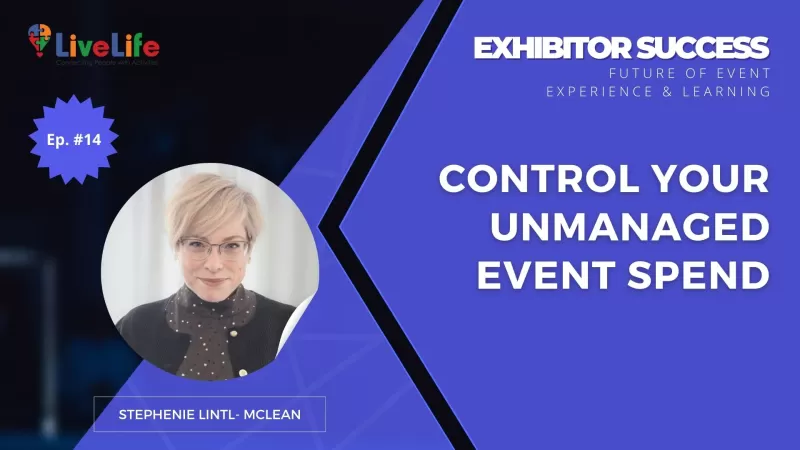
This is the summary based on The FEEL Podcast with Stephenie Lintl-McLean.
Why companies fail to report all internal events accurately
Imagine an IT project with a million-dollar budget running on every computer in the company.
Now imagine that project had no oversight, no hard numbers, and no reported business relevance.
This is exactly how most enterprise-level companies treat their event portfolios today.
The siloing effect: Why different departments hide event spend
Events are happening everywhere, from HR orientations to regional sales kick-offs.
Because these are managed by different departments, they often bypass the central event team.
This lack of budget administration creates a "rogue" event culture where spend is never consolidated.
Moving past the old-fashioned myth that event impact is impossible to measure
Leadership often clings to the idea that events are "soft" marketing.
Event teams sometimes hide behind this myth to avoid the pressure of hard KPIs.
If you can't measure it, you can't manage it—and if you can't manage it, you can't scale it.
How to track and manage unmanaged event spend in large companies
To effectively track and manage unmanaged event spend, you must first acknowledge the invisible portfolio.
This requires a shift from viewing events as one-off parties to viewing them as business assets.
The "IT Project Parity" framework is the fastest way to change this internal perception.
The IT Project Benchmark: Applying software-level rigors to event management
Ask your leadership if they would allow an IT project to run without a clear ROI methodology.
The answer is always no, yet they allow event portfolios of the same value to run unmanaged.
By framing events as "software for human connection," you demand the same level of data-driven oversight.
Ready to audit your event portfolio? Book FREE consultation to identify your unmanaged spend.
Starting the conversation: Auditing reported vs. unreported events across departments
The first step is a cross-departmental conversation about what is actually happening.
Ask every department head: "How many events do we have happening, whether they are reported or not?"
You aren't looking for a perfect list; you are looking for the "last bastion" of unmanaged spend.
How to create a methodology for measuring event business relevance
The word "methodology" often sounds too academic for busy event planners.
In reality, it is simply a roadmap for where your information comes from.
Without a clear methodology, you are just guessing at the value of your portfolio.
Defining your data source: Why methodology is simpler than you think
You don't need a PhD to build a measurement system for your events.
You simply need to decide which tools will serve as your "source of truth."
Clarity on the source is more important than the complexity of the data itself.
How to get event data from crm and feedback forms for executive reporting
Your CRM should be the primary destination for all attendee interaction data.
Feedback forms should be standardized across all departments to ensure data parity.
When these two sources speak to each other, you create a narrative of business relevance.
What are the risks of allowing event spend to remain unmanaged
Allowing event spend to stay "off the books" isn't just a reporting error; it's a financial risk.
Unmanaged spend leads to redundant vendor contracts and wasted departmental resources.
It also prevents the company from seeing the true impact of its physical marketing footprint.
The million-dollar leak: The cost of failing to aggregate event portfolios
When events are siloed, you lose the ability to negotiate enterprise-level vendor rates.
You also lose the data that proves which events are driving revenue and which are just noise.
Aggregating your portfolio is the only way to turn a "black hole" into a profit center.
For more insights on the future of event data, subscribe to The FEEL Podcast on your favorite platform.

Frequently Asked Questions
Q1: Why is unmanaged event spend so common in large companies?Unmanaged event spend occurs because events are often decentralized. Different departments, such as HR, Sales, and Marketing, plan their own functions without centralizing the budget. This leads to a lack of visibility for procurement and leadership, making it the "last bastion" of unmanaged corporate spend.
Q2: How can I identify unreported events in my company?Start by conducting a cross-departmental audit. Ask department heads for a list of all gatherings, regardless of size or budget. Reviewing budget administration records for "marketing expenses" or "travel and entertainment" often reveals hidden event costs that haven't been funneled through the central event team.
Q3: What is the best way to get event data from CRM systems?To get event data from CRM systems, ensure every event registration is synced with a lead or contact record. Use unique campaign IDs for each event. This allows you to track the attendee's journey post-event and see how the interaction contributed to the sales pipeline or customer retention.
Q4: Why do event teams resist formal measurement methodologies?Many teams believe that "methodology" is an academic burden that takes time away from execution. There is also a lingering "old-fashioned" belief that the value of an event is purely emotional and cannot be quantified. Overcoming this requires showing that methodology is simply about defining data sources.
Q5: Can feedback forms provide enough data for executive reporting?Feedback forms are excellent for qualitative data, but they must be paired with CRM data for executive reporting. While forms tell you how attendees "felt," the CRM tells you what they "did" after the event. Combining these provides a full picture of business relevance.
Q6: What is the "IT Project Parity" framework?This framework compares the management of event portfolios to the management of IT projects. It highlights the double standard where companies demand high data transparency for software spend but allow million-dollar event budgets to go unmanaged. It is used to advocate for better event governance.
Main Article

Related Articles
Banner

Write a comment