
How to be Successful at Trade Shows Without Selling
Imagine you are walking down a trade show aisle and you see a crowd gathered around a booth. Every person in that group is holding a small, brightly colored object. They aren't just looking; they are engaged in a shared activity.
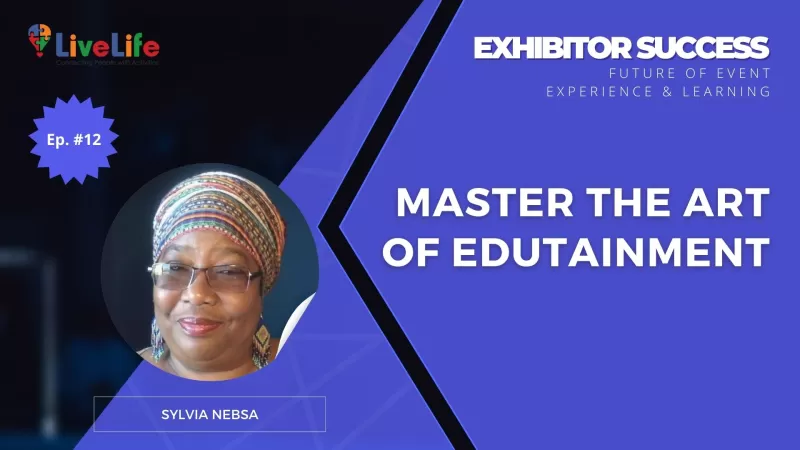
This is the summary based on The FEEL Podcast with Sylvia Nebsa.
You naturally slow down. You wonder, "What is everyone holding? Why are they so interested?" By the time you realize it’s a service-based business, you’ve already been hooked by the collective energy of the booth.
If you want to hear this moment explained directly, specifically how the physical "vibe" of a crowd creates a magnetic pull that no brochure can match, listen to the raw conversation behind these sensory triggers at The FEEL Podcast.
Many exhibitors struggle with how to sell services at trade shows because their offering is "invisible." Unlike a gadget or a piece of machinery, a service is theoretical. However, the secret to tripling your results is to stop selling the "process" and start selling the "transformation" through a tactile, edutaining experience.
Why Service-Based Booths Often Fail to Engage
The most common mistake service providers make is relying on "talk." Because they have no physical product to show, they fill the silence with technical features, company history, or long-winded bios about their founders.
The hidden cost of this approach is immediate visitor fatigue. Trade show attendees are tired, overstimulated, and their heads are already full of data. They don't want to hear about your great-grandfather’s legacy; they want to know how you can help them right now.
When you focus on features rather than benefits, you miss the opportunity to create an impulse buy or a gateway transaction. To succeed, you must move away from the "office presentation" mindset and toward an "edutainment" model that combines education with entertainment.
This shift is easier to achieve when your trade show booth experience turns talk into tangible interaction.
The Tactile Secret: Turning Theory into Touch
You might think, "I sell consulting or software; I don't have anything for them to hold." This is exactly where most teams get stuck. To learn how to sell services at trade shows effectively, you must create a physical model of your service.
Humans have a primordial need for tactile experiences. The sense of touch is a non-negotiable for building trust quickly. When you put a physical representation of your service in a prospect's hand, it enters their "realm." It becomes real to them.
Making the Invisible Visible
- Physical Props: If you sell data security, use a physical "vault" or a tangible "security key" during your demo.
- The Mannequin Tactic: When one visitor holds your model, others stop to see what it is. You effectively turn your visitors into mannequins that display the value of your service to the rest of the aisle.
- Sensory Engagement: Beyond touch, consider how your service can be represented through sight, sound, or even smell. The goal is to engage the senses so the prospect remembers the $2 of your booth, not just the pitch.
How to Sell Benefits Instead of Features
Engineers and subject matter experts are often "turned on" by the intricate features of their service. However, the buyer only cares about the solution to their pain point.
The better way to handle the interaction is the "Show, Ask, and Tell" methodology.
- Show: A high-impact, tactile demonstration of the result.
- Ask: Questions that identify the visitor's specific bottleneck.
- Tell: Explaining the benefits that specifically solve that bottleneck.
If you are currently reflecting on how to translate your complex B2B offering into a high-impact floor experience, Mike Gunawan is available for an open invitation for discussion, reflection, or strategic exchange.
By focusing on "how to sell benefits instead of features," you help the buyer spend more with you because they see the total value of the transformation you offer. You aren't "squeezing" them for money; you are helping them three times more by providing a comprehensive solution.
How This Connects to the Bigger System
Knowing how to sell services at trade shows is the final piece of the "Triple Your Sales" framework. Once you have used curiosity to attract people and frictionless engagement to speed up the interaction, you must use edutainment to maximize the transaction value.
This works best when combined with a full framework of loose scripts and practiced strategies. When your team knows how to move from a "teacher" role to a "demonstrator" role seamlessly, they can engage a crowd while focusing on a single person.
By creating an uplifting, unforgettable experience, you ensure that even if they don't sign a contract on the floor, you have secured the "gateway offer"—the first step in a long-term B2B deal.

Frequently Asked Questions (FAQ)
Q1: How to sell services at trade shows if I donSelling services requires "materializing" the service. You should develop a physical model, a deck of "insight cards," or a tactile tool that represents the problem you solve. By giving the visitor something to hold, you engage their tactile senses and make your theoretical service feel like a tangible reality. This stops them from just "listening" and starts them "experiencing."
Q2: How to engage booth visitors faster when the service is complex?To engage visitors quickly, you must simplify the complex. Don't start with the architecture of your service; start with a "wow/aha factor" result. Use a pattern-interrupt hook to identify their pain point in under ten seconds, then use a physical prop to show the "after" state of your service. Complexity is for the follow-up office meeting; the trade show floor is for inspiration and curiosity.
Q3: How to increase impulse buying at trade shows for B2B services?Impulse buying in B2B often looks like a "gateway offer"—a low-friction first step such as a paid audit, a sample kit, or a trial membership. To increase these, you must make the demonstration "edutaining." If the prospect feels good and sees an immediate benefit, they are much more likely to commit to a small transaction on the spot to keep the momentum going.
Q4: Why is edutainment better than a standard sales pitch?A standard pitch feels like work for the visitor. Edutainment (Education + Entertainment) feels like a gift. By teaching them something valuable in an engaging, high-energy way, you activate the law of reciprocity. They are much more likely to give you their time and contact information because you’ve provided an uplifting experience rather than just a dry list of service features.
Q5: How to sell benefits instead of features to tired attendees?Tired attendees have a very low "bandwidth" for technical details. They are looking for "relief." When you talk about features, you are asking them to do the mental work of figuring out how those features help them. When you speak directly to benefits—how you save them time, reduce their stress, or increase their profit—you are providing the answer they are looking for without making them work for it.
Main Article

Related Articles
Banner
Write a comment