
Should We Accept Low B2B Tradeshow Conversion Rates?
-
Relying strictly on a baseline 1–2% B2B trade show conversion rate is a flawed approach; success must be evaluated against product ticket size, total event investment, and reasonable outcomes.
-
Internal sales-marketing dysfunction acts as a hidden barrier to growth, with marketing driving booth budgets and sales staffing the floor, resulting in severe handover gaps.
-
An alarming 60–70% of booth visitors never receive a proper post-event follow-up, causing brands to lose massive pipeline value, future buyers, and referral networks.
-
Improving conversions requires mapping the complete visitor journey, defining precise roles for on-site execution, and shifting metrics from raw lead volume to interaction quality.
-
Maximizing event ROI means recognizing that trade shows are relationship-driven ecosystems where long-term trust and aligned team execution matter far more than flashy vanity metrics.
This is the summary based on The FEEL Podcast with Subhanjan Sarkar.
When exhibitors talk about success at tradeshows, the conversation often circles back to one key number: B2B tradeshow conversion rate. In B2B exhibitions, this figure is often quoted as 1–2%. But here's the question—should we really accept that?
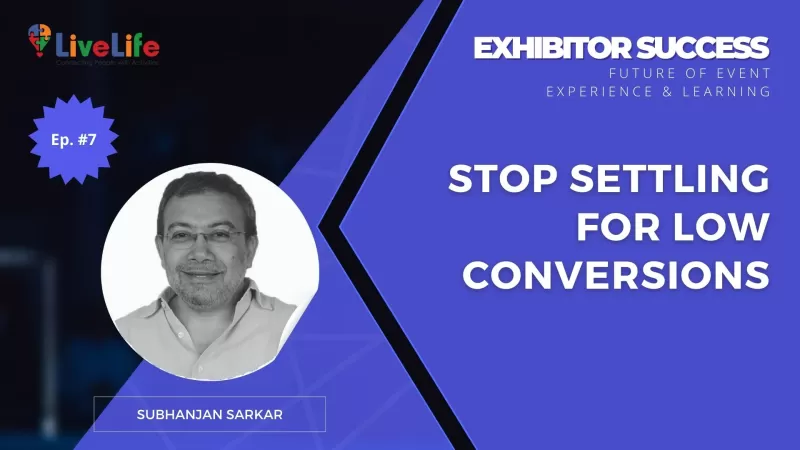
During The FEEL: Future of Event Experience & Learning podcast, Subhanjan Sarkar shared an important perspective: "I don't think you should see 1–2% as the right conversion rate. What matters is the ticket size of your product, the investment in the tradeshow, and the reasonable outcome."
In other words, closing one deal worth $1 million could make a low percentage perfectly acceptable. But the story doesn't end there.
The Hidden Problem: Sales-Marketing Dysfunction
One reason B2B tradeshow conversion rates remain stubbornly low has nothing to do with prospects—and everything to do with how companies manage their exhibitions.
Marketing teams usually control the budget, while sales teams are the ones actually manning the booth. This disconnect creates a “handover problem” where responsibilities blur, follow-ups get missed, and opportunities slip away.
Subhanjan noted that 60–70% of booth visitors never receive a follow-up properly. Imagine the potential lost in that number.
Even if they aren't your direct audience, they could be a referral source or a future customer. But without engagement, they'll simply walk away and forget your brand.
A strong B2B tradeshow conversion rate strategy involves aligning sales and marketing and ensuring every visitor is nurtured post-event.
Mapping the Visitor Journey
To fix this, exhibitors need to think beyond conversion percentages and map the entire visitor journey. That means:
- Tracking each stage of interaction, from badge scanning to booth conversations to follow-up.
- Aligning sales and marketing teams so they work as one unit, not two separate silos.
- Defining clear roles and responsibilities—who does the scanning, who qualifies leads, and who follows up.
- Measuring results consistently, not just counting leads but evaluating engagement quality.
When this mapping is missing, the "ball gets dropped." Marketing celebrates lead volume, sales complains about lead quality, and the exhibition ROI becomes murky.
A thoughtful B2B tradeshow conversion rate improvement plan focuses on quality interactions, not just numbers.
Quality Over Quantity
So, should we accept a low B2B tradeshow conversion rate? The answer is nuanced. If the outcome aligns with your investment and target deal size, the numbers themselves aren't the problem.
But what's not acceptable is losing opportunities simply because of poor alignment or lack of follow-up. Visitors came to your booth for a reason.
Even if they don't buy today, treating them well can pay off later—through referrals, partnerships, or a deal months down the line.
The Real Takeaway
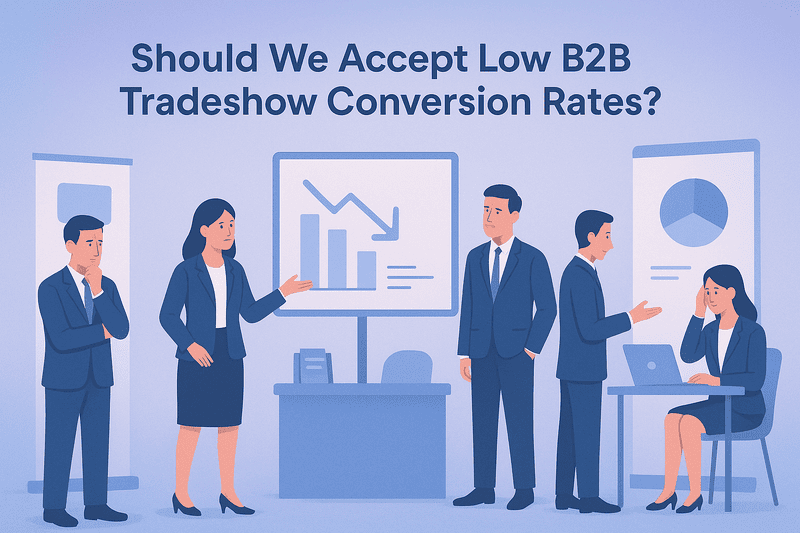
Tradeshows aren't just about generating leads; they're about building trust and relationships. A 1–2% B2B tradeshow conversion rate might be fine if your deals are high-ticket. But a 60–70% follow-up failure rate? That's not fine.
The real opportunity is to rethink how we measure tradeshow success. Instead of focusing solely on percentages, we should ask:
- Did we engage visitors meaningfully?
- Did we align sales and marketing across the visitor journey?
- Did we capture and nurture opportunities beyond the event floor?
Because at the end of the day, conversions are not just numbers. They're a reflection of how well we connected with people.
Low B2B tradeshow conversion rates aren't destiny. They can shift dramatically with a consistent exhibition follow-up strategy.
What's been your experience? As an exhibitor or a visitor, have you seen opportunities lost because of poor alignment or lack of follow-up? Would love to hear your stories.
Watch the conversation on The Feel Podcast.
Need personalized guidance on B2B tradeshow conversion rate?
Follow Mike Gunawan on Linkedin.

Frequently Asked Questions
Q1: Why is a low 1–2% B2B trade show conversion rate acceptable for some companies but highly problematic for others?A low 1–2% conversion rate is acceptable if an organization sells high-ticket, million-dollar products where closing a single deal justifies the entire exhibition investment. However, it becomes highly problematic when the low percentage is driven by internal operational failures, uncoordinated team execution, and a lack of proper lead nurturing rather than strategic deal positioning.
Q2: What are the primary root causes of the sales-marketing handover problem at B2B exhibitions?The handover problem stems from a lack of functional alignment and shared ownership over the attendee journey. Marketing teams typically control the trade show budget and focus on high lead generation numbers, while sales teams staff the physical booth and demand high-intent lead quality; without pre-planned coordination, roles become blurred and valuable prospects slip through the cracks.
Q3: How does a high post-event follow-up failure rate impact an exhibitor's long-term brand equity and pipeline?When 60–70% of booth visitors are completely neglected after an event, exhibitors lose substantial pipeline revenue and severely damage their long-term brand equity. Even if a visitor is not an immediate buyer, failing to engage them ignores their potential to become a high-value referral source, a strategic corporate partner, or a qualified customer months down the line.
Q4: What operational steps should exhibitors take to successfully map out the trade show visitor journey?Exhibitors must systematically track every interaction touchpoint by integrating badge scanning, live booth conversations, and digital follow-up workflows into a single system. This requires sales and marketing to operate as a cohesive unit, establishing clear responsibilities for who qualifies leads on the floor, and deploying data-driven CRM tracking to evaluate engagement quality over raw volume.
Q5: How should corporate leaders re-evaluate and measure trade show success beyond traditional lead counting?Corporate leaders should shift their focus from superficial lead volume and vanity percentages to deep relational metrics. True exhibition success should be measured by evaluating whether booth staff engaged visitors meaningfully, whether sales and marketing workflows were synchronized across the journey, and whether the organization successfully captured and nurtured long-term pipeline opportunities beyond the event floor.
Main Article

Related Articles
Banner

Write a comment